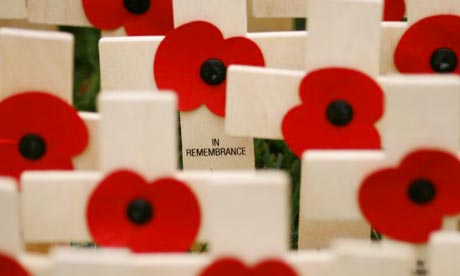
Showing posts with label Remembrance Sunday 9th November. Show all posts

Remembering...

Saw this excellent post on the Vernacular Curate's blog...

~~~~~

"When you see that old man walking a little bent, just think he was once a proud young matloe [the nickname for a sailor] swinging along, head held high. When you sit next to him in church and see tears in his eyes when he sings “oh hear us when we pray to thee, for those in peril on the sea” – his thoughts go out to the night he was torpedoed and still hears those cries for help – he survived, but he will always remember those cries.

The man down the road who tells you about his army days ay “Cassino” and the day he went back to the scene of the “battle” [otherwise known as the Battle of Rome, 1944] many years later – he remembers the shattered monastery rebuilt, how lovely it looks, how peaceful; now the organ playing; a place for prayer and outside just the song of the birds. He looks around at the hills and sees the Polish cemetery now so serene and peaceful and then he goes down the hill and sees the German cemetery – he says a prayer for them. They were only lads like himself doing their duty for their country. Then on to the British and Commonwealth cemetery where he sees a headstone that bears a name he knows. He stops to says ‘hello’ and on and on to see many more names and thinks what a lovely cemetery this is, we have done these boys proud – but with tears in his eyes – he thinks of his son and daughter, his grandchildren and then of the families of those boys and what might have been.

Perhaps, when you are walking the dog near that old airfield, you saw a man standing looking at the old ‘dispersal bay’ and then towards the old billets, now derelict. He thinks to himself ‘that was once my home’; he thinks of the good times and the sad times and of the empty beds (usually seven); he looks towards the control tower and can still hear the WAAFs voice calling them home. Now his eyes look to the skies, he is thinking of his old “Lanc” can hear the sound of the Merlins and a feeling of tense fear and excitement runs though his body – he is now on his way to Germany and now back again, sitting down to hot tea, egg and bacon. But he thinks of the last night he saw the dispersal bay – the night he lost six of his best friends. The target was Karlsruhe. One moment they were a crew – a team – and then fate stepped in and the Lancaster was just a ball of fire hurtling earthwards. He still can’t believe how, with his parachute still intact, he was thrown into the air. He is now thinking how lucky he was to be a P.O.W. as now he can come back and look at the old airfield, but now his thoughts go back again to Germany and the boys in that row of graves, and although he had known them only a short time, what a privilege it was to claim them as friends.

Let’s also think of the S.O.E. agents [Special Operations Executive], Odette, Violette Szabo and many more, the Special Duties Squadrons that took them into enemy territory. Theirs was a very silent war and so often forgotten.

As we remember of servicemen let’s not forget the man down the road. When asked what he did, he says “well, I was a firemen”: he didn’t tell you of the days and nights he spent away from home, fire-fighting in London, Portsmouth, Coventry etc. – the smell of death, the bombs still falling; the same goes for so many more unsung heroes who gave so much – the police, ARP, Home Guard, WVS, nurses, doctors, ambulance crews, Salvation Army, Church Army, the clergy, all transport workers, munitions, parachute and clothing workers, the Land Army and so many more. Let us also not forget the brave Merchant Seamen, the evacuees and those who took them in – so many brave people, so many more names. Not forgetting the people who were bombed out of their homes but still kept cheerful, the people who took them in, the refugees from Europe.

At remembrance time let us think of those men and women of all wars, past and present, the people maimed by war and still suffering to this day. Think of the widows and families, especially those too old to visit the graves of their loved ones. Also think of those people who work for the Commonwealth War Graves Commission who tend those graves so lovingly.

So, when some old “codger” takes a little longer to get on the bus, or pack his trolley in the supermarket, let’s not say, “come on granny or grandad”, but think: these were the same men and women who, when their country called said ‘here we are!’

...instead let us say “thank you, granny and grandad”

This piece was written in the 1980s by Ricky Dyson and his wife Mavis. Ricky was a rear-gunner on the Lancaster Bombers during the Second World War, and was one of a very few who survived. He was decorated with the George Cross for his bravery. Ricky died some time after writing this piece, though Mavis is still a member of our church family. Ricky was a true hero of the War, and I dedicate this post to him, his friends, and all the fallen in our World Wars.
Cracking services this morning but I am exhausted now... Herewith a version of my sermon for Remembrance Sunday (with thanks to those who helped!)

There are very few people left who can recall the slaughter of the Somme or
Passchaendale, but there will be those, who like me, have been told stories about it. It is hard now to believe that Northern France and Belgium were the scenes of such carnage.

There are, though, those here today who remember the second world war. People who know what Dunkirk and D-day were really like, people who experienced being prisoners of war in the Far East, people who lost friends or family members. For them, this act of Remembrance is particularly poignant.
There are others here today who wait anxiously for the safe return of those they care about from Afghanistan or Iraq, knowing that there have been many wounded and killed in those conflicts. And there are those who are not with us today because they are now serving in Afghanistan or iraq.

Remembrance is important for all of us, young and old, perhaps it is of even greater importance for those of us who have not been affected personally by war. For war puts into stark contrast the choices we have in life, choices between good and evil. If we look to the second world war, there were many individual acts of bravery. Men who ran to rescue their injured fellows under heavy gunfire. Those who went back onto the beaches to help another. Those who went into the wrecked shells of houses to look for the injured. Those who risked capture and death by hiding Jews. Not only those who laid down their lives for their country and friends, but those who laid down their lives for people they did not know, who were not of their religion. Is that not the greatest love that humankind can show?

But war is not all heroism. There were those who looked after themselves first, those who gave no thought or respect for individual lives. In both wars there were those who turned their back on the injured. But worst of all there were those who turned their back on love completely. Those who tortured, starved and gassed men women and children.

It is no different today. Nor was it in any other age. We must not forget that we too can be raised so high or sink so low. If we have not been put to the test we cannot be sure how we will behave. We must keep alive the memories of the war. We must tell our children and make sure that they tell their children. For we must all be made aware of the choices before us, and the pressures of war show so clearly where the paths lead - on the one hand to selfless love, on the other to denial of love, denial of our own humanity.

If we turn our back on love, we inflict pain upon each other and upon God.
Yet it is so easy to turn away from love when our prejudice makes us fail to see Christ within another person, fail to see a person at all.

When a teacher treats a child as just another pupil instead of seeing him or her as a unique and valuable individual, when an employer cuts the work force and sees only numbers not names, when a government sees the homeless as an unfortunate problem that is damaging tourism, and fails to care about its causes, when a church cares only about its members and ignores the cries for help from outside its walls, then we are ignoring the soul within, we are loving selectively, we are inflicting pain. These are the seeds that if fed with a little fear and a little hate can lead to Atrocities.

The only God who can be worshipped on this Remembrance Sunday, indeed any day, is a God who suffers with us. At the heart of our faith as Christians lies the fact that Jesus of Nazareth, who reveals God to us, dies. The crucifixion of Jesus rescues us from naïve optimism because it identifies God with our pain and suffering.

The death of Jesus shows God bearing the pain most visibly, God suffers. There is no easy way out, no legions of angels flying to the rescue. God like us suffers. Like us when faced with unbearable grief, Jesus shouts ‘why me’‘My God, My God, why have you forsaken me’

Yes some of us have personal memories of war and its affects and aftermath, others of us are shocked by its contemprary clinical brutality on other shores, but we believe in a God who speaks to us of goodness in the world. We are confronted all around us by evil, but so too are we faced daily by goodness. There are great saints as well as appalling sinners. The great love that we know in others is a love which finds its source not in a meaningless universe, the result of an accident.

Jesus, the Son of Man, man as God intended man to be, perfect in love, shows us that love by giving his life for us. That perfection of love, perfection of humanity should be our aim. Look again at his story. He was thrashed, then stretched out upon a cross, humiliated, ridiculed, bleeding and in agony. Men did that to him. Ordinary men, with homes and families, but men who turned their back on love, or who chose to love selectively. Each one of us has within us the potential to evil such as this. It can slip so easily, so unobtrusively into our lives that we do not even notice its presence.

Remembrance Sunday is about the past. It is there to honour those who gave their lives for others. Today, here as we remember those who have died, we also remember Jesus Christ raised from the dead. The risen Jesus offers us hope that the power of death and sin in the world do not have the last word, rather God who who had the first word in creating us does! Remembrance Sunday must be about Jesus Christ. For through his death on the cross, Jesus doesn’t just suffer with those who suffered and continue to suffer because of war, rather he offerered his persecutors forgiveness and reconcilliation.

We, by bearing his name, made in his image and empowered by his spirit as we gather to remember today, personally, locally, nationally and internationally, must seek to do the same. Amen
Ping your blog, website, or RSS feed for Free